
The Creative Process Behind Ink Artwork
The Art of Letting Creativity Flow
Some artistic techniques demand absolute precision. Others invite experimentation, unpredictability, and discovery.
Ink artwork can combine both.
The ink art process allows artists to explore how color, movement, layering, and surface interactions contribute to a finished composition.
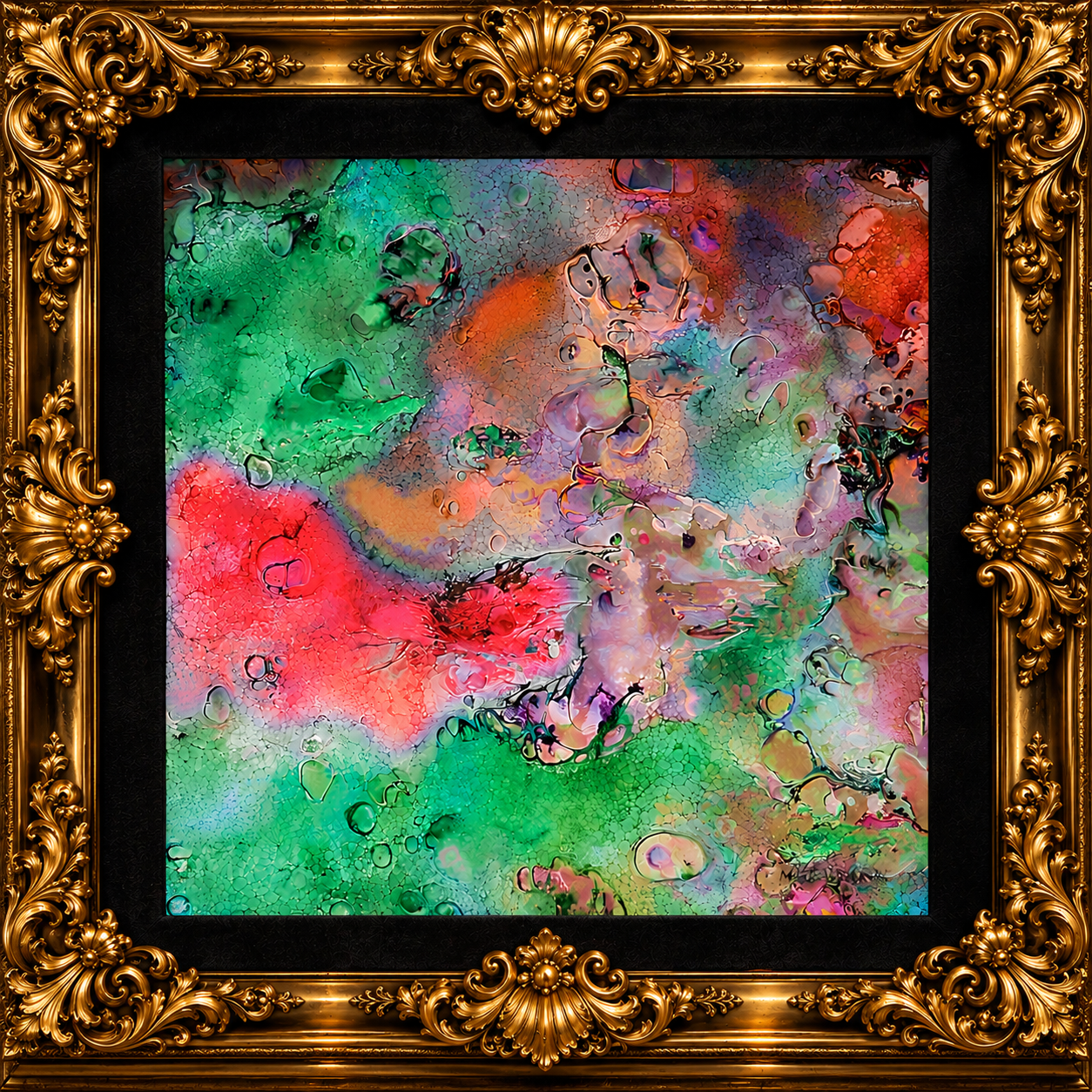
Depending on the materials and techniques used, ink can produce delicate transitions, bold contrasts, organic patterns, and intricate details.
For viewers, the result can feel almost alive.
For artists, the creative journey is often just as fascinating as the finished piece.
1. Every Composition Begins With an Idea
The creative process may begin with an emotion, a color combination, a memory, or simply the desire to explore something unexpected.
Some artists develop detailed concepts before working. Others approach the surface intuitively, allowing the composition to evolve through experimentation.
Both approaches can produce compelling artwork.
A color palette may establish the initial direction, but the relationships between pigments and shapes often influence the final visual experience.
This balance between planning and discovery is part of what makes experimental ink artwork so engaging.
2. Understanding Color and Movement
Color is one of the most powerful elements of abstract ink art.
Bright pigments can create energy and excitement, while muted colors introduce subtlety and calm.
The interaction between colors also matters.
Complementary hues may create dramatic contrast, while closely related colors can produce smooth visual transitions.
Movement introduces another dimension.
Depending on the technique, artists may guide ink using brushes, controlled pouring, airflow, tilting, or other methods suited to the materials.
These actions influence how pigments spread, overlap, and settle.
The resulting shapes can suggest flowing water, geological formations, atmospheric patterns, or entirely imaginary landscapes.
3. Texture Adds Depth and Character
One of the most intriguing qualities of experimental abstract artwork is its surface detail.
Some techniques produce delicate lines and translucent layers. Others create intricate cellular patterns, branching shapes, or areas of strong contrast.
These details invite closer inspection.
From a distance, viewers may see a sweeping composition of color.
Up close, they may discover tiny patterns, subtle transitions, and visual relationships that were not immediately apparent.
This layered viewing experience helps make abstract ink art especially compelling.
4. The Role of Experimentation
Experimentation is central to many forms of ink art.
Artists may test different pigment concentrations, surfaces, layering approaches, and application methods.
Even small adjustments can change the final appearance.
Environmental conditions and material properties may also affect how pigments behave.
The artist's challenge is to recognize which unexpected developments strengthen the composition and which require further refinement.
Rather than treating every unpredictable result as a mistake, experimental artists can use discovery as part of their creative vocabulary.
5. Knowing When a Piece Is Complete
One of the most challenging decisions in abstract art is knowing when to stop.
Adding another color, shape, or layer can enhance a composition, but it can also disrupt its balance.
Artists consider how the elements work together.
Does the composition have a focal point? Do the colors create a sense of harmony or intentional tension? Does the artwork communicate the intended feeling?
Sometimes a piece reaches completion through careful refinement.
Other times, the strongest decision is to preserve an unexpected moment.
6. From Creative Experiment to Finished Artwork
The journey from initial concept to finished artwork involves more than applying pigment.
Artists must also consider presentation, preservation, and how the work will be experienced.
Appropriate finishing methods depend on the specific ink, surface, and materials involved.
Lighting, framing, and display choices can significantly influence the viewer's experience.
A carefully presented piece allows the colors, textures, and composition to become the focus.
Explore the World of Ink Art With Mark Warsocki
Mark Warsocki's artwork celebrates the visual possibilities of bold color, abstract composition, and intricate detail.
Through Ink Art & Photography, viewers can explore artwork that encourages imagination and personal interpretation.
Each composition offers an opportunity to appreciate the relationship between artistic intention and visual discovery.
Visit inkartphotography.com to explore Mark Warsocki's abstract artwork and discover the expressive power of ink-inspired creativity.
Suggested image alt text: “Close-up of vibrant abstract ink artwork showing colorful fluid patterns and intricate textures.”
October Blog — The Evolution of Photography as an Art Form
Primary keyword: photography history art | Category: Fine Art Photography
The Evolution of Photography as an Art Form: From Documentation to Creative Expression
SEO Title: The Evolution of Photography as an Art Form | Mark Warsocki
Meta Description: Explore photography history and art, from early photographic inventions to modern fine art photography. Discover the creative vision of Mark Warsocki.
Suggested URL: /blog/evolution-of-photography-as-an-art-form
More Than a Photograph
Photography has transformed the way people experience the world.
What began as a technological breakthrough for recording images eventually developed into one of the most influential forms of artistic expression.
Today, photography occupies a respected place in museums, galleries, private collections, and contemporary visual culture.
But the journey from early photographic experiments to modern fine art photography involved decades of innovation, debate, and artistic exploration.
Understanding that evolution helps us appreciate photography not simply as a record of reality, but as an art form shaped by human vision.
1. The Birth of Photography
The foundations of photography emerged through scientific and technical experimentation.
In the 1820s, Nicéphore Niépce produced one of the earliest surviving photographs using a light-sensitive process.
In 1839, Louis Daguerre's daguerreotype process was publicly introduced, helping establish photography as a practical means of image-making.
Early photographs required specialized equipment and often lengthy exposures.
Portraiture, architecture, and landscapes became important subjects as the technology developed.
Photography offered something remarkable: the ability to preserve visual details with a degree of accuracy that had previously been difficult to achieve.
Yet from the beginning, photographers also made artistic choices about composition, lighting, subject matter, and perspective.
2. Photography Becomes an Artistic Medium
During the nineteenth century, photographers began exploring the medium's expressive possibilities.
Some embraced an approach later associated with Pictorialism, using soft focus, atmospheric lighting, and specialized printing methods to create images with painterly qualities.
These photographers sought to demonstrate that photography could communicate mood, beauty, and emotion rather than simply reproduce visible facts.
By the early twentieth century, other photographers increasingly championed sharp detail, strong composition, and the distinctive visual qualities of the photographic medium itself.
These differing approaches helped establish photography as a creative discipline with its own artistic language.
3. The Power of Black-and-White Photography
Black-and-white photography became a defining medium for artistic expression.
Without color, photographers could emphasize contrast, texture, light, shadow, and geometric relationships.
A portrait could reveal emotional depth through subtle expressions and tonal variations.
A landscape could become dramatic through the relationship between illuminated surfaces and deep shadows.
Photographers such as Ansel Adams demonstrated how technical mastery and artistic vision could transform natural landscapes into powerful visual experiences.
Black-and-white photography remains relevant today because its apparent simplicity can create extraordinary emotional and compositional impact.
4. Color Photography Changes the Creative Landscape
Although color photographic processes developed over many decades, color photography became increasingly accessible and influential during the twentieth century.
Artists began exploring how color could contribute to narrative, atmosphere, and visual identity.
Color could now serve as more than descriptive information.
It could become the central subject of a photograph.
Photographers such as William Eggleston helped expand recognition of color photography within fine art institutions.
Everyday scenes, ordinary objects, and familiar environments could become visually compelling through careful attention to color and composition.
This development broadened the possibilities of photographic art.
5. The Digital Revolution
The emergence of digital photography transformed both image-making and distribution.
Digital cameras allowed photographers to review images immediately, experiment with exposure, and refine techniques without the same material constraints associated with film.
Editing software expanded the possibilities for tonal adjustments, compositing, color grading, and experimental visual treatments.
Online galleries and digital platforms also made photographic work accessible to audiences far beyond traditional exhibition spaces.
However, technology alone does not create artistic meaning.
A compelling photograph still depends on the photographer's ability to recognize an interesting subject, construct a thoughtful composition, and communicate a perspective.
6. Photography in Contemporary Fine Art
Today, fine art photography encompasses an extraordinary range of styles.
Artists explore portraiture, landscapes, architecture, macro photography, conceptual imagery, abstraction, and experimental techniques.
Some photographers focus on capturing fleeting moments.
Others carefully construct scenes or use photography as the foundation for more elaborate artistic compositions.
Fine art photography is often distinguished by the artist's intention and creative vision rather than by a particular subject or camera.
The question is not simply what the photograph shows.
It is what the artist wants the viewer to experience.
7. Why Fine Art Photography Appeals to Collectors
Photography offers collectors a way to engage with the world through another person's perspective.
A carefully composed photograph can reveal beauty in overlooked details, transform an ordinary subject, or preserve an emotionally meaningful moment.
Collectors may consider artistic originality, print quality, edition size, presentation, provenance, and personal connection when choosing photographic works.
A thoughtfully selected photograph can become a lasting focal point in a home, office, or gallery.
Above all, fine art photography invites viewers to see familiar subjects differently.
Discover Fine Art Photography by Mark Warsocki
At Ink Art & Photography, Mark Warsocki brings together an appreciation for visual detail, composition, and artistic expression.
His photography offers viewers an opportunity to explore the world through a creative lens, complementing his colorful abstract artwork.
Whether you are interested in photography as an art form or searching for a distinctive addition to your collection, the possibilities are extensive.
Explore the photography and fine art collections at inkartphotography.com and experience the world through Mark Warsocki's artistic perspective.
Suggested image alt text: “Fine art photography displayed in an elegant gallery, illustrating photography's development as an artistic medium.”
